
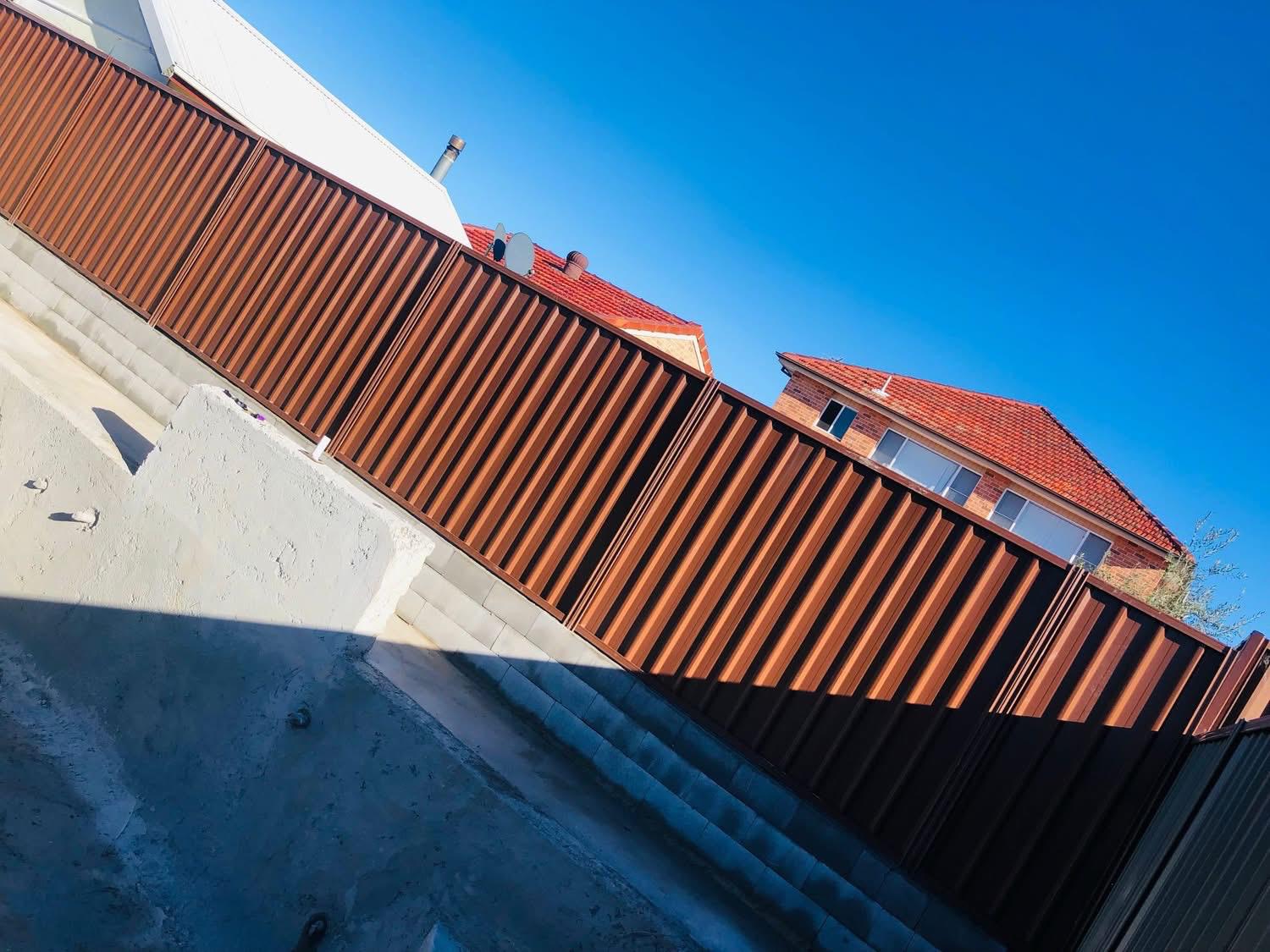
Colorbond Fencing Camden
Colorbond fencing around Camden, from rear boundaries on the older town blocks to long exposed runs where the yards meet open paddocks.
Colorbond Fencing in Camden
Camden still feels like a country town at its centre and turns into open river flats and paddocks a few streets out. That mix shows up in the fencing. In the older streets near the main road the houses have character frontages that no owner wants to hide behind steel, while the blocks on the edge of town back onto grazing land with the wind coming straight across.
Our approach reflects that. In town we keep Colorbond behind the front building line, running down the sides and across the rear where it gives privacy without changing how the house presents to the street. On the fringe blocks the priority is structural, because a long solid fence with a paddock on one side takes real wind load. We shorten the post spacing, deepen the footings and step the panels where the ground rolls away toward the river flats.
Every Camden quote is written after an on-site measure that takes in the fall, the exposure and where the gates need to sit. Call 0492 879 796 to book a free measure.
What We Install in Camden
- Rear and side boundary fencing
- Wind rated posts for open paddock runs
- Stepped panels over rolling ground
- Fencing behind heritage frontages
- Wide double gates for trailers
- Sleeper bases on uneven ground
- Slat extensions for extra privacy
- Removal of old timber and wire fences
Colorbond Fencing Options in Camden
Town Block Boundaries
Side and rear fencing for the older Camden streets, kept behind the front building line.
Paddock Edge Runs
Wind rated construction for boundaries with open grazing land on the other side.
Rolling Ground Steps
Panels stepped in even increments where a Camden block falls toward the flats.
Trailer and Float Gates
Extra wide double gates sized for a box trailer, boat or horse float.
Sleeper Bases
Treated sleepers under panels where the ground is uneven or has been built up.
Old Fence Clearing
Removal of failing timber, wire and star picket boundaries, including strainer posts.
Colorbond Fencing Service Area Around Camden
Colorbond Fencing Camden FAQs
Can I use Colorbond on the front boundary of an older Camden home?
In the heritage parts of Camden it is usually the wrong choice and may need council approval. Camden Council pays attention to what happens forward of the building line in the conservation areas near the town centre, where a picket or low masonry frontage suits the streetscape. The practical answer most owners land on is a traditional front fence with Colorbond starting behind the facade for the side and rear boundaries.
How do you build for wind on the edge of town?
A solid fence with open paddock on one side catches everything, and the load ends up in the footings. On those Camden boundaries we reduce the spacing between posts compared with a standard suburban layout and increase footing depth and diameter. We also avoid running a very long unbroken line where the ground allows a natural break. Doing this at install time costs a fraction of straightening a leaning fence later.
What is the process for sharing the cost with next door?
Under the NSW Dividing Fences Act 1991 a standard dividing fence is a shared cost between adjoining owners, usually half each. You start with a fencing notice, which sets out in writing what you propose to build, who will build it and what it will cost. On the semi-rural Camden boundaries it is worth discussing what sufficient means first, because a neighbour with stock may consider wire adequate for their purposes.
Do you make gates wide enough for a horse float?
Yes. Around Camden we build a lot of double gates in the three to four metre range for floats, boats and box trailers, framed in steel and sheeted to match the fence. Wide gates need proper hardware, so we use heavy adjustable hinges and a drop bolt in the centre to keep the leaves steady, and we check the swing against the driveway fall before setting the posts.
Is colourbond a good match for a rural property?
It works very well where you want privacy and a clean line, such as around a house yard, a pool or a garden. Colourbond, spelled Colorbond by BlueScope, is not intended as a stock fence for a whole paddock, and wire remains the sensible choice for that. Many Camden properties end up with both, steel around the home and wire on the outer boundaries.
Get YourFree Quote Today
Contact Sydney's trusted fencing contractors and landscape designers
Contact Information
Address
77 Garfield St
Wentworthville NSW 2145
ABN
75 644 310 547
Serving All Sydney
Professional since 2016
Why Choose Us?
Free Quotes
No-obligation assessments across Sydney
9+ Years Experience
Established local business
Licensed & Insured
Full compliance and protection
Quality Materials
Premium suppliers and warranties
On-Time Completion
Reliable project delivery
Competitive Pricing
Best value for money
Ready to Get Started?
Contact us today for your free consultation and quote
Professional Fencing & Landscaping Services Sydney
Transform your Sydney property with expert fencing contractors and landscape designers