
What Changes the Cost of a Colorbond Fence in Sydney
We do not publish rates, because a metre of fence on a flat Blacktown block and a metre on a Hills District slope are not the same product. Here is what actually moves a quote.
Last updated: 7 August 2026
Last updated 7 August 2026. Written by the team at Fencing and Landscaping Experts, Wentworthville NSW. General information only, current at the date shown. Always confirm the position for your own address with your council or a qualified certifier.
Why we do not publish a rate per metre
A published rate per metre is only meaningful if every metre is the same, and in Sydney it never is. The same fence across a flat, clear, truck-accessible boundary in Marsden Park and across a stepped, rock-affected, barrow-only boundary in Hornsby involves different quantities of labour, different footings and different materials. A rate that covers both is either wrong for one of them or padded for both.
What we can do, and what this page sets out, is explain exactly which variables move a quote. Once you know those, you can look at any quote you receive and tell whether it has been priced from the site or from a spreadsheet.
It also lets you have a useful conversation about scope. Several of the factors below are things you can decide about, and understanding them is the difference between a quote you accept and a quote you negotiate.
Panel height
Height is the most direct driver because it changes the quantity of sheet, the rail configuration and, above a certain point, the post and footing specification. A taller fence is not simply proportionally more expensive; past a point it becomes a different structure, because wind loading rises and posts and footings have to be upsized to suit.
This is why an extension above a standard boundary height often costs more than owners expect. Adding a slat or lattice top to an existing run is one thing. Building the whole run taller is another, because the load path changes from the ground up.
It is also where council controls bite. Front boundaries and anything above conventional height may need approval, and that has its own time and cost implications.
Slope and stepping
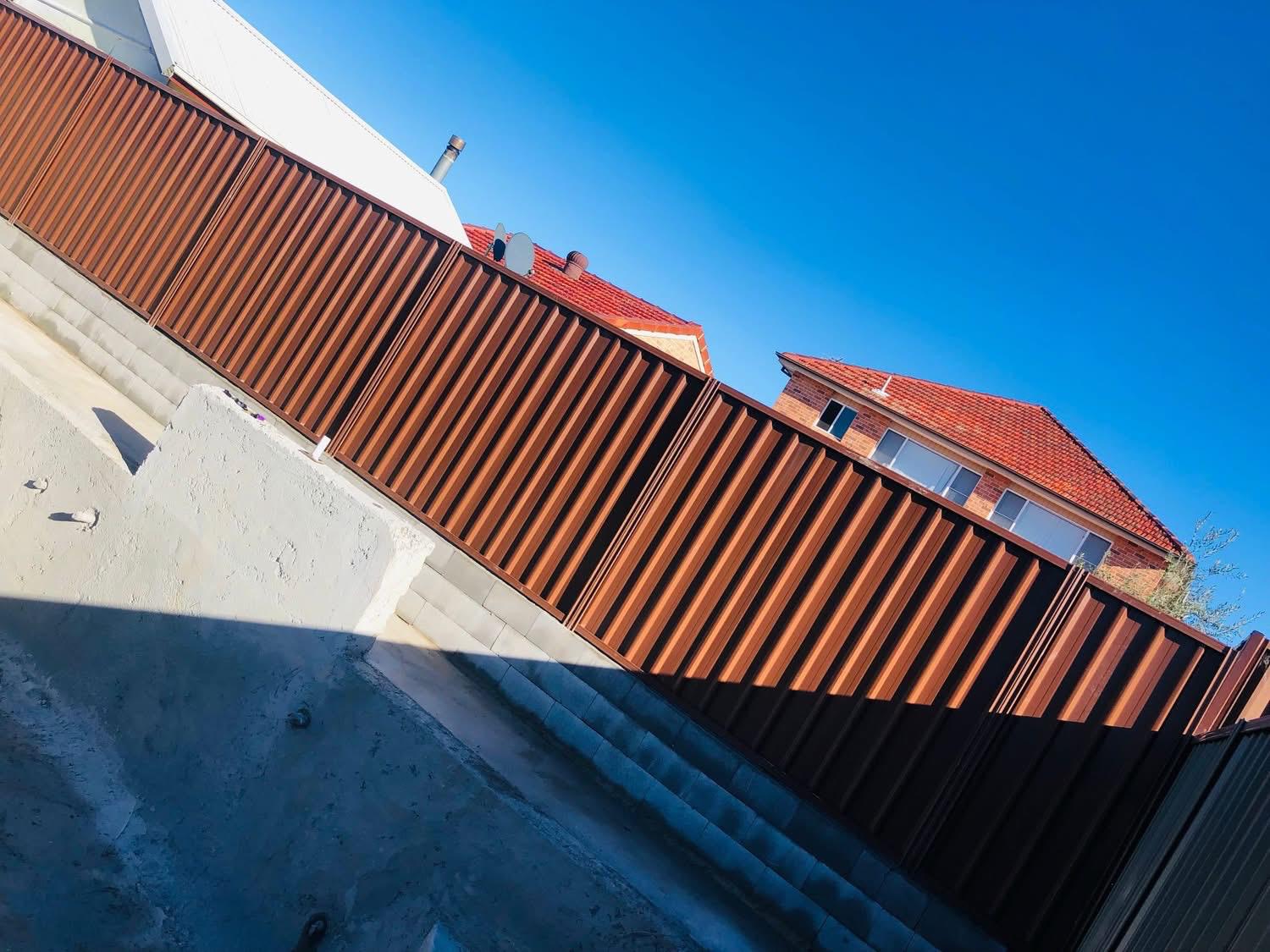
A boundary that falls has to be either stepped or raked, and both take longer than a level run. Stepping holds each panel level and drops it in increments, which reads crisp from the street but leaves triangular gaps at the base that have to be closed. Raking angles the panel to follow the ground, which suits a steady grade but requires cut sheets and more set-out time.
Slope is the factor most often missed in a phone quote and most often discovered on the day. It affects labour, it usually creates a plinth requirement, and on a long run it can change the number of posts.
It is also why we walk the run before quoting. A fall of a metre across a side boundary is easy to see on site and invisible from an address.
Removing and disposing of the old fence
Taking out an existing fence is a separate scope from installing a new one, and its cost depends on what is there. A timber paling fence with posts set in soil comes out relatively easily. Posts set in large concrete footings, a masonry base, or a fence with asbestos containing sheeting attached are all substantially more involved and, in the last case, require licensed handling.
Disposal is a real cost that some quotes omit and then add later. Ask whether removal and tipping are included, because a quote that excludes them is not comparable with one that includes them.
On older properties across the inner west, Blacktown and the Parramatta area, fibro sheeting and asbestos containing material are a genuine possibility. If it is found, work stops and licensed removal is arranged. That is not a cost anyone can absorb quietly.
Retaining, plinths and level differences
Where two properties sit at different levels, something has to hold the higher side up. A concrete plinth under the fence line handles a modest difference. A genuine level change needs a retaining wall, which is a separate structure with its own drainage, engineering and approval requirements. This is frequently the largest single variable on a sloping site.
Benched estate lots across the north west and south west growth areas, and the cut and fill blocks of the Hills District and Campbelltown, run into this constantly. The fence is the visible part; the retaining underneath it is where the work is.
If a quote for a sloping boundary makes no mention of plinths or retaining, that is a question worth asking before you accept it.
Site access and ground conditions
Access determines whether materials and spoil move by vehicle or by hand, and that difference runs through the whole program. Ground conditions determine how the footings are dug. Rock, tree roots, existing concrete, buried services and heavy clay all slow excavation, and hand digging is significantly slower than machine digging.
On the sandstone country through Hornsby, the Sutherland Shire and the northern beaches, rock at post depth is common and drilling is often required. On the shale clays across western Sydney the issue is not hardness but reactivity, which means wider and deeper footings.
Narrow side access, zero lot boundaries, steep driveways, rear lane only access and neighbouring construction all fall into the same category. None of them are unusual; all of them change the price.
Gates, hardware and colour
Gates cost more per metre than fence because they involve a frame, hinges, a latch, a heavier post and a larger footing. Hardware quality varies enormously and it is where the cheapest quotes save money. Colour, by contrast, generally does not move the price much, because the standard Colorbond fencing range is priced consistently and the choice is aesthetic.
A gate is the part of a fence that fails first, because it is the only part that moves. Adjustable hinges, a properly braced frame and a gate post with a footing sized for a moving load are what separate a gate that still swings properly in ten years from one that scrapes the path in two.
Where a colour sits outside the standard fencing range, availability and lead time can become the issue rather than price. We check the current range before quoting a specific colour.
How to compare two Colorbond quotes properly
Compare scope before you compare anything else. Two quotes for the same boundary can differ substantially and both be honest, because one includes removal, disposal, a plinth and a gate, and the other does not. Ask each contractor to itemise, and ask specifically about the seven factors on this page.
The questions that reveal the most are: is removal and tipping included, how is the fall being handled, is a plinth allowed for, what footing depth is allowed for the ground here, what hardware is on the gate, and what happens if rock or asbestos is found.
Our quotes are written from a site visit and itemised so each of those is visible. Call 0492 879 796 and we will measure the run, photograph the fall, and put it in writing.
- Is removal of the old fence and tipping included
- How is the fall along the boundary being handled
- Is a plinth or retaining allowed for
- What footing depth is allowed for this ground
- What hardware is specified on the gates
- What happens if rock, services or asbestos are found
- Is the quote fixed or subject to site conditions
The Seven Factors That Move a Colorbond Quote
Colorbond Cost Questions
Because the factors that move the price are on the site, not in the address. Slope, access, what is coming out, whether a plinth is needed and what the ground does at post depth all have to be seen. A phone figure that ignores those is either a guess that gets revised, or padded to cover the worst case. A site visit is free and takes about twenty minutes.
On a flat, clear suburban boundary it is usually the removal and disposal of the old fence. On a sloping block it is almost always the level change, because stepping, plinths or retaining are involved. On a tight or steep site it is access, because hand carting materials changes the labour on every stage of the job.
Within the standard Colorbond fencing range, generally not in any meaningful way, so choose the colour you actually want. What can change is availability and lead time for less common colours. We check the current range before we quote a specific colour so there are no surprises about timing.
Not exactly. Up to a point the extra cost tracks the extra sheet. Past that point the post size, footing size and rail configuration all change because of wind loading, so the cost steps up rather than climbing smoothly. Extra height may also bring council approval into the picture.
We tell you before we proceed. Rock at post depth means drilling and a variation, and we would rather flag the risk in the quote than surprise you with it. Asbestos containing material means work stops in that area and licensed removal is arranged. Neither is something a contractor can quietly absorb.
It is possible but it rarely works out well. Quantities, panel modules, post spacings and the accessories that make a run look right are easy to get wrong, and a shortfall halfway through a job stops it. Where owners have done this, the saving has usually been consumed by return trips and offcuts.
Get YourFree Quote Today
Contact Sydney's trusted fencing contractors and landscape designers
Contact Information
Address
77 Garfield St
Wentworthville NSW 2145
ABN
75 644 310 547
Serving All Sydney
Professional since 2016
Why Choose Us?
Free Quotes
No-obligation assessments across Sydney
9+ Years Experience
Established local business
Licensed & Insured
Full compliance and protection
Quality Materials
Premium suppliers and warranties
On-Time Completion
Reliable project delivery
Competitive Pricing
Best value for money
Ready to Get Started?
Contact us today for your free consultation and quote
Professional Fencing & Landscaping Services Sydney
Transform your Sydney property with expert fencing contractors and landscape designers