
Sydney Fencing Cost Guide
Every fence type, and the site and scope factors that move the number on the quote. No rates, because rates without a site are fiction.
Last updated: 7 August 2026
Last updated 7 August 2026. Written by the team at Fencing and Landscaping Experts, Wentworthville NSW. General information only, current at the date shown. Always confirm the position for your own address with your council or a qualified certifier.
What determines the cost of a fence in Sydney?
Four things, in roughly this order: the material and height you choose, what the site does along the boundary, what has to come out before the new fence goes in, and how easily materials and spoil can move on and off the property. Material is the factor owners focus on, and it is usually the smallest of the four on a difficult site.
That order surprises people. Two identical Colorbond runs, one on a flat suburban block with truck access and one on a stepped, rock-affected boundary with barrow-only access, can differ substantially with no change to the product at all.
This guide works through each fence type and then through the site factors that apply to all of them. Nothing here is a rate, because a rate without a site is a guess.
Colorbond and steel fencing
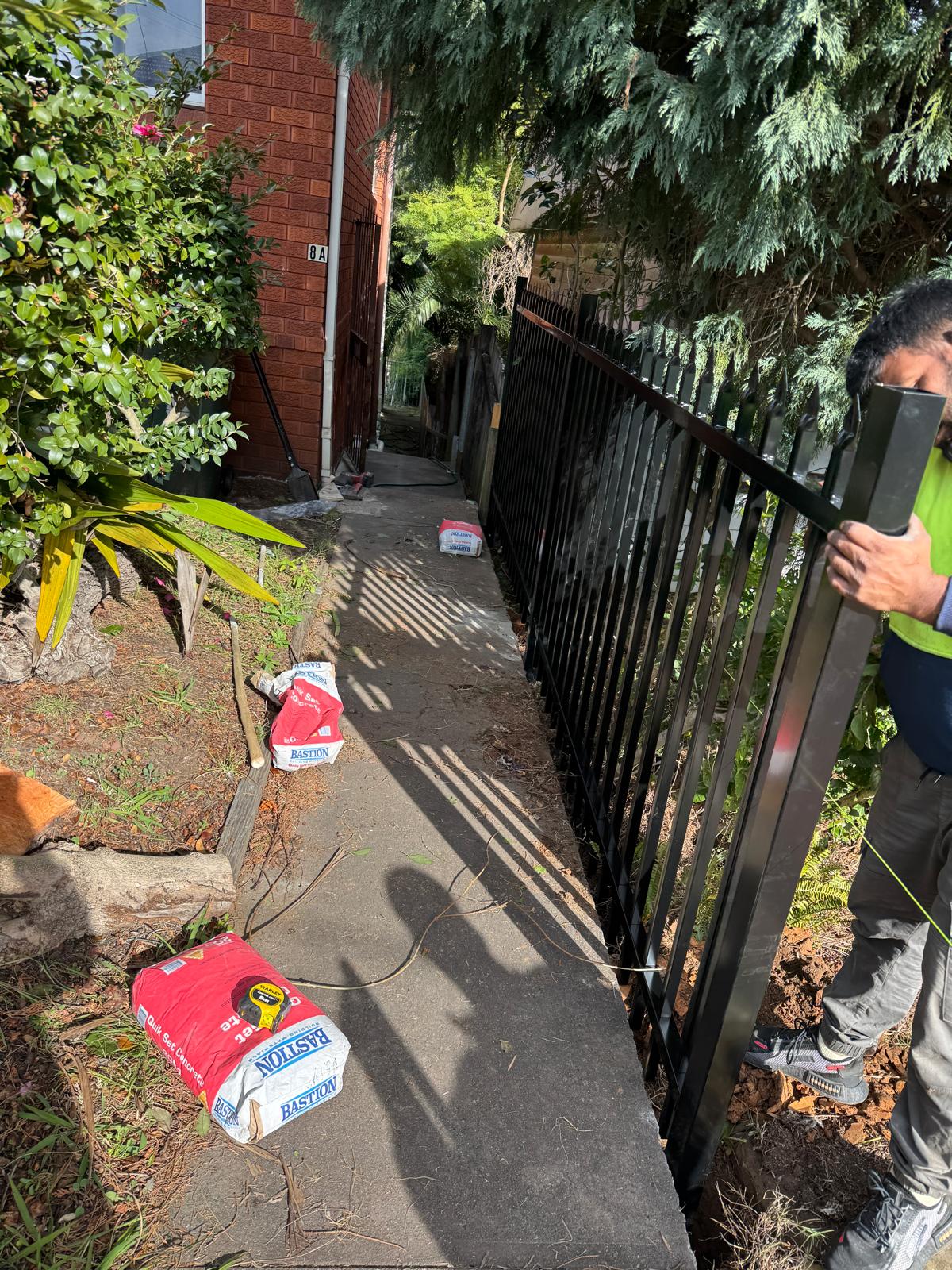
Colorbond is priced by panel module, so the cost drivers are height, the number of posts, and how the fall along the boundary is handled. Stepping and raking both add set-out time, and stepping usually creates a plinth requirement. Removal of the old timber fence and disposal of it is a separate and often significant line.
Colour within the standard fencing range does not generally change the cost. Heavier acoustic profiles, extra height and slat or lattice extensions do. Corner and return runs cost more per metre than long straight runs because each change of direction needs its own post and set-out.
Timber fencing
Timber cost is driven by species, by the format, and by what happens at ground level. Lapped and capped uses more timber than butted paling. Hardwood costs more than treated pine and lasts longer. Posts set into concrete with a plinth or a galvanised stirrup cost more than posts dropped into soil, and they are the reason one fence outlives another.
The cheapest timber quote is almost always the one that puts untreated or lightly treated posts straight into the ground. That is where the saving is, and that is where the fence fails first.
Aluminium slat fencing
Aluminium is priced by the extrusion, so blade width, blade spacing and the frame system drive the material component. Powder coat colour and finish matter more here than with steel, because specialty and woodgrain finishes carry a premium. Because panels are lighter, footings are sized for wind load rather than weight, which can reduce excavation on a straightforward site.
Aluminium frontages usually involve more gates, more returns and more piers than a rear boundary run, and those are the elements that carry the labour.
Glass pool fencing
Glass is priced by panel and by fixing method. Frameless panels on spigots cost more than semi frameless panels between posts, and the fixing substrate matters: core drilling into a concrete slab is a different operation from fixing to a timber deck or to a paved surface on sand. Gate hardware for a pool barrier is specified for compliance rather than price.
On coastal sites through the beaches and the shire, marine grade stainless fittings are the sensible specification, and they carry a premium that is worth paying once rather than replacing twice.
Security fencing, 358 mesh and palisade
Security fencing is priced on the specification rather than the length. A 358 anti-climb mesh perimeter, a palisade line and a chainwire boundary are three different products at three different levels of protection. Finish is the second driver: hot dip galvanising after fabrication costs more than a pre-galvanised product and lasts considerably longer.
Gates carry a disproportionate share of the cost on any security perimeter, because a cantilever sliding gate involves substantial posts, footings and, usually, automation. Height, topping details and anti-tamper fixings all move the number.
Because commercial perimeters are made to order, changes after fabrication are expensive. The specification conversation is worth having properly at the start.
Automatic gates
An automatic gate is three costs in one: the leaf, the automation, and the civil work. The leaf is priced like fencing. The automation is priced on leaf weight, leaf length and duty cycle together. The civil work covers footings sized for a moving load, conduit, power supply, and the safety devices that any powered gate needs.
Sliding gates need a run-back at least as long as the opening; where there is no room for one, a cantilever design or a swing pair is required and the cost changes accordingly. On a driveway that rises from the street, swing geometry becomes the constraint.
Safety beams, force limiting, battery backup and a manual release are not optional extras on a powered gate, and a quote that omits them is not comparable with one that includes them.
Rural and acreage fencing
Rural fencing is priced by the run, and the run is priced by its ends. Strainer assemblies at corners, ends and grade changes carry most of the labour, so a paddock with many corners costs more per metre than a long straight boundary. Horse mesh, post and rail and plain wire are very different specifications for the same nominal job.
Access matters more on acreage than anywhere else, because materials have to be distributed along a run that may be hundreds of metres from the nearest gate.
The site factors that apply to every fence type
Regardless of material, five site factors move a fencing quote: the fall along the boundary, the ground at post depth, access for materials and spoil, what has to be demolished and disposed of, and whether any level difference needs a plinth or a retaining wall. Any one of them can outweigh the choice of material.
Ground conditions vary dramatically across Sydney. Reactive shale clay through the west and south west requires wider and deeper footings. Sandstone through the north and the shire requires drilling. Sand along the coast requires wider footings for lateral resistance. None of these are exceptional; all of them change the excavation.
The most useful thing you can do before collecting quotes is to walk the boundary yourself and note the fall, the access, what is currently there, and whether the two properties sit at different levels. Then ask every contractor how they have allowed for each.
- Fall along the boundary and how it is handled
- Ground at post depth: clay, rock, sand or fill
- Access for materials, machinery and spoil
- Demolition and disposal of the existing fence
- Level differences requiring a plinth or retaining
- Gates, hardware and any automation
- Approvals where the fence is at the front or unusually high
Fence Types Covered
Fencing Cost Questions
Because a price without a site is not information, it is a lead magnet. The factors that move a fencing quote in Sydney are almost all site factors, and publishing a rate would mislead about half the people who read it. What we can do, and what this page does, is tell you exactly what to ask about so you can compare quotes properly.
For a straightforward rear boundary, timber paling and Colorbond are usually the two most economical options, and which of them wins depends on the site and on what is being removed. Over a longer horizon, steel generally costs less because there is no timber in the ground to fail. On a difficult site, the site factors matter more than the choice between them.
Almost always because the scopes differ. One includes removal and disposal, a plinth, a gate and a footing depth suited to the ground, and the other does not. Ask both to itemise. The difference is usually visible immediately once the line items are side by side.
Usually a little, because mobilisation, set-out and delivery are spread over more metres. The effect is smaller than people expect, and it is easily wiped out by a change of direction, a grade change or a section with poor access. Corners and gates cost far more per metre than straight runs.
Get at least two, and make sure they are quoting the same scope. Three quotes for three different scopes tells you nothing. Give each contractor the same information about what you want removed, what you want built and where, and ask each to itemise the site allowances.
Disposal of the old fence, followed by the plinth or retaining needed where the two properties sit at different levels. Both are easy to leave out of a quick quote and both are unavoidable once work starts. Ask about them explicitly.
Get YourFree Quote Today
Contact Sydney's trusted fencing contractors and landscape designers
Contact Information
Address
77 Garfield St
Wentworthville NSW 2145
ABN
75 644 310 547
Serving All Sydney
Professional since 2016
Why Choose Us?
Free Quotes
No-obligation assessments across Sydney
9+ Years Experience
Established local business
Licensed & Insured
Full compliance and protection
Quality Materials
Premium suppliers and warranties
On-Time Completion
Reliable project delivery
Competitive Pricing
Best value for money
Ready to Get Started?
Contact us today for your free consultation and quote
Professional Fencing & Landscaping Services Sydney
Transform your Sydney property with expert fencing contractors and landscape designers